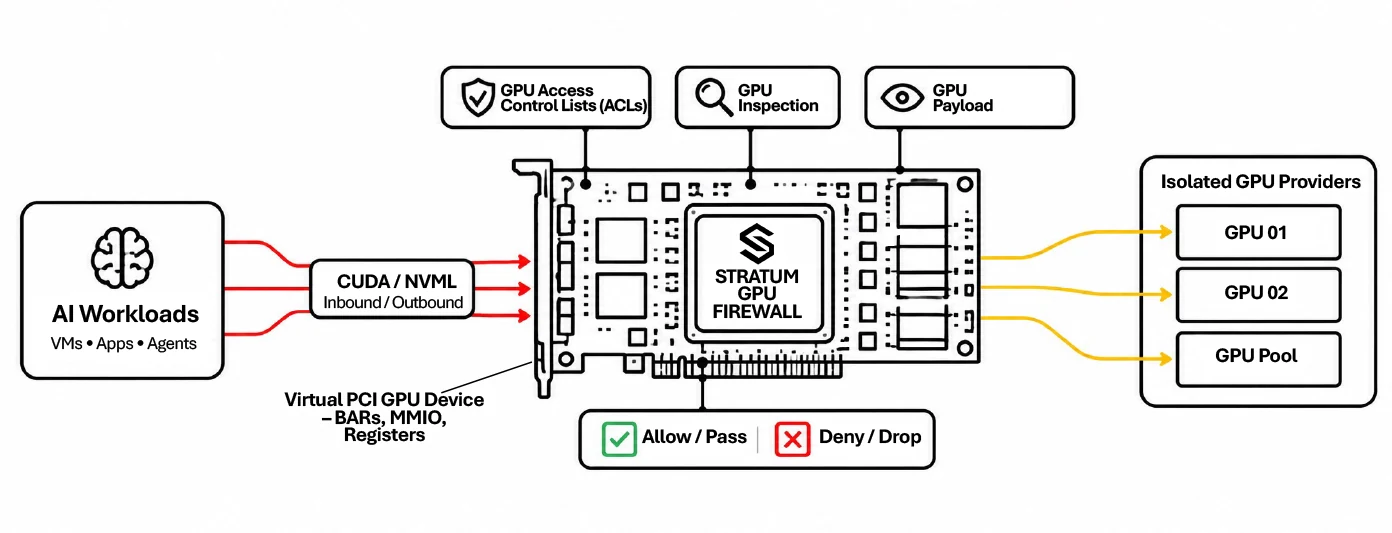
GPU compute should not be handcuffed to one server, one VM, or a vendor licensing stack. STRATUM Virtual GPU is a virtual PCI hardware device presented directly to the guest, complete with BARs, MMIO, and registers. Behind that guest-visible GPU is STRATUM GPU, the single choke point where we route real CUDA workloads, enforce leases, apply the GPU Firewall, and connect workloads to GPUs over IP. We control the virtual PCI device. We control the infrastructure boundary. A physical GPU stops being tied to a machine and becomes an allocatable resource in the STRATUM Continuum.
GPU Splicing, aka Soft-MIG, turns one supported physical GPU into 2–16 independently allocatable logical GPU resources, each capable of executing real CUDA workloads on the parent GPU. Every guest CUDA process has its own context; each VM gets a software-enforced VRAM budget, with usage accounted across its provider processes using NVIDIA driver reporting. Compute is time-sliced, not divided into hard partitions. This is not a simulated GPU, hardware MIG, SR-IOV, or perfect tenant isolation. It is first-class Accelerator Fabric orchestration built around the virtual device we own, not a hardware feature we have to wait for.
Now scale that idea beyond the rack. An x86-64 VM can consume a slice backed by a GPU on an Arm64 host, even across distant datacenters, while the host's existing Linux stack handles NVIDIA drivers, InfiniBand, and NVLink. No NVIDIA vGPU software subscription. No requirement for MIG-capable silicon. No replacement golden Linux image. Just STRATUM, running as an application, turning physical accelerators into controlled, shareable infrastructure. One GPU becomes up to sixteen resources. One Continuum turns those resources into global capacity. This is the STRATUM way.