USE CASES / DEFENSE

The operating layer
beneath the mission.

Build once. Vet once. Deliver the datacenter everywhere.

STRATUM / USE CASES

Version the infrastructure alongside the mission software. Move the operating environment between sites and systems.

The Fleet. Packaged.

Not another pane of glass. A layer of command.

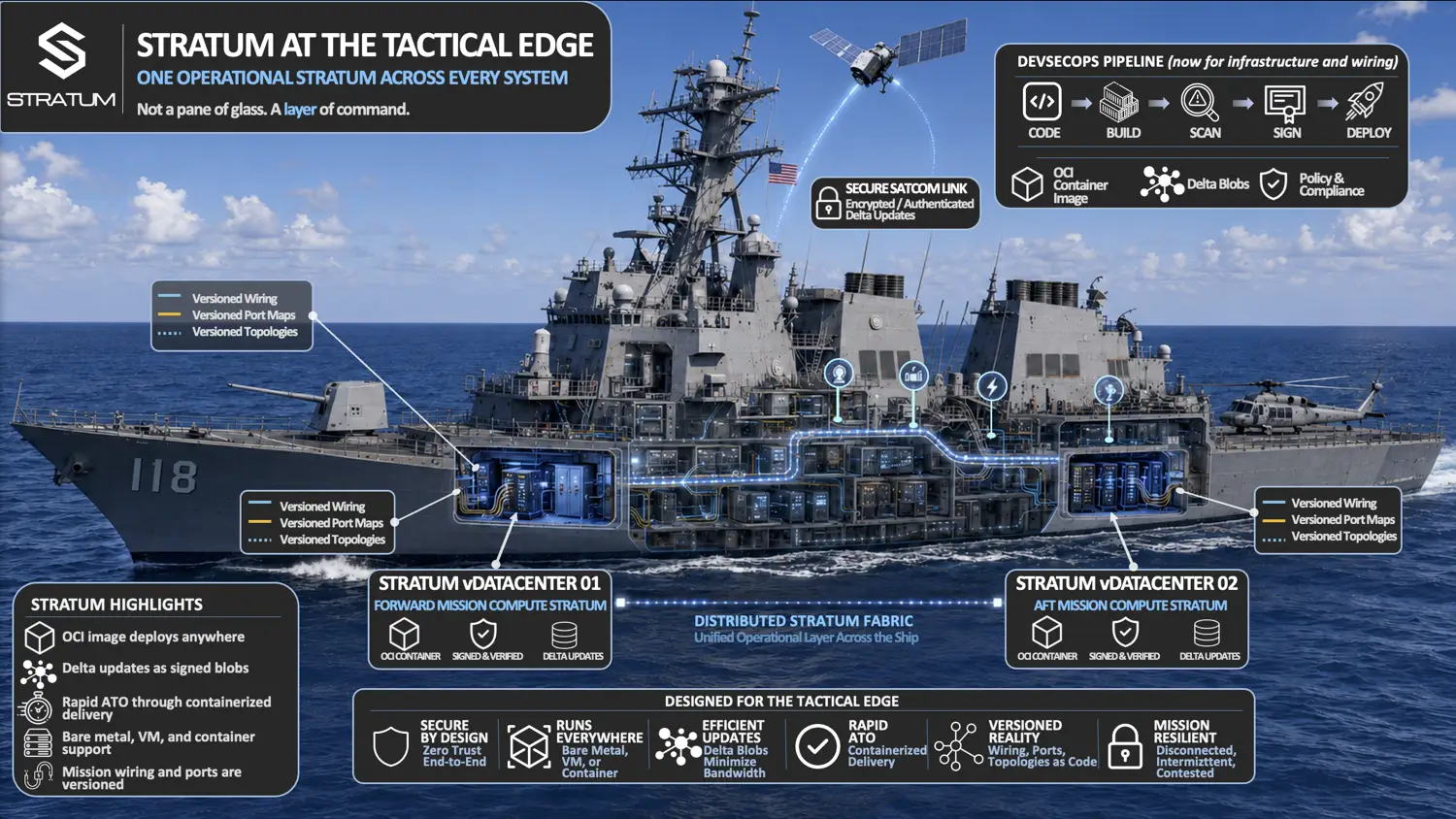
STRATUM across a Navy ship, satellite communications, software pipeline, and versioned mission infrastructure
The same versioned platform model across ships, shoreside systems, cloud, and tactical infrastructure. VIEW FULL SIZE ↗

Infrastructure delivery for the fleet.

The datacenter becomes part of the software delivery model.

From Software Armory to Infrastructure Armory

Promote the platform with the mission software.

STRATUM extends rapid delivery beyond applications. Complete virtual datacenter platforms can move through established DevSecOps processes and into ships, shore facilities, laboratories, cloud environments, and tactical edge systems.

Security Evidence Travels With the Platform

Evidence is generated with the release.

Image identity, software bill of materials, vulnerability results, configuration, and release provenance can stay associated with the infrastructure artifact promoted through the pipeline.

Build Once. Promote Many. Operate Fleet-Wide.

Infrastructure. Downloaded.

A STRATUM release is a known, version-controlled infrastructure artifact. Promote the same approved release across ships, shore facilities, labs, sovereign cloud, remote sites, and tactical edge systems.

Deliver Mission Infrastructure at Software Speed

Not merely the application.

The platform beneath it. The network around it. The storage behind it. The GPUs that accelerate it. The wiring that connects it all.

Hardened at the foundation.
Built for the mission.

STRATUM starts with Platform One's Iron Bank container foundation.

STRATUM's container is built on a hardened image foundation from Platform One's Iron Bank, the Department of War repository of vetted container images. That foundation fits the way defense and regulated enterprises evaluate software: through transparent provenance, repeatable container delivery and security evidence.

Iron Bank images are scanned daily for vulnerabilities, with SBOMs and risk assessments supporting informed software supply-chain decisions. STRATUM pairs that foundation with versioned OCI delivery and the ability to run on the Linux hosts your organization already hardens and supports.

DAILYVulnerability scans
SBOMSoftware bill of materials
RISKAssessment evidence

STRATUM is post-quantum.

Mission infrastructure should be ready for the cryptographic transition before the deadline arrives.

STRATUM was built from the ground up with post-quantum cryptography in its security roadmap and Continuum architecture. STRATUM supports all three NIST-standardized PQC algorithm families: FIPS 203 ML-KEM for quantum-resistant key establishment, FIPS 204 ML-DSA for lattice-based digital signatures, and FIPS 205 SLH-DSA for stateless hash-based digital signatures.

Hybrid quantum-resistant network encryption lets Continuum deployments combine established classical protection with NIST-standardized PQC as the Federal Government accelerates migration. Executive Order 14412 directs the transition of Federal information systems toward NIST-approved post-quantum FIPS and sets concrete migration objectives for high-value and high-impact systems.

For defense infrastructure that may remain deployed for years, the problem begins now. Traffic collected today may still be valuable when future cryptanalytic capability arrives. STRATUM brings PQC into the same operating layer that connects datacenters, sovereign cloud, ships, aircraft, edge platforms, and mission systems.

POST-QUANTUM TECHNICAL GUIDE ↗
FIPS 203ML-KEM
FIPS 204ML-DSA
FIPS 205SLH-DSA

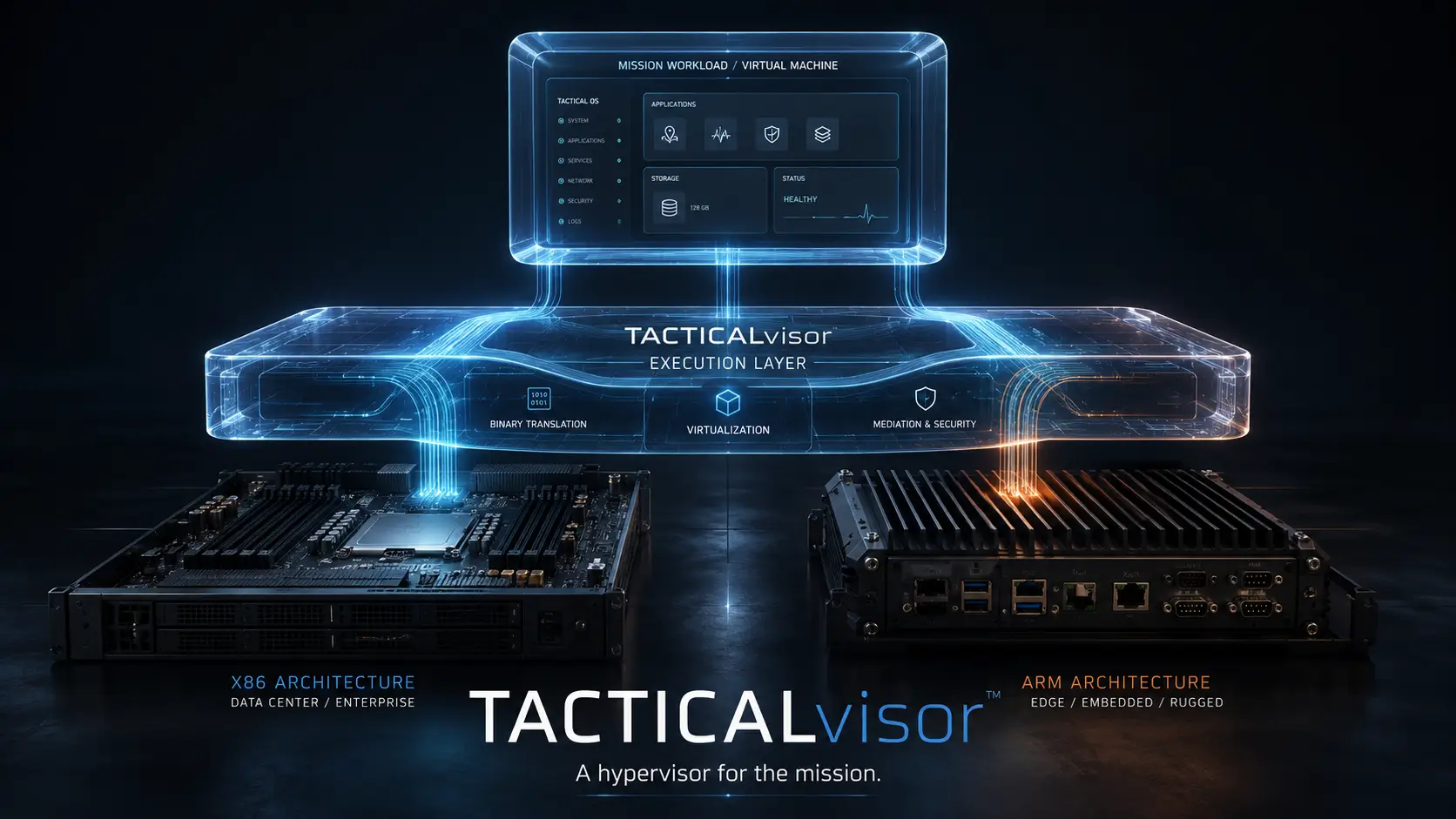
When the host cannot give you a hypervisor, bring your own.

The smallest piece of STRATUM delivers its biggest tactical advantage.

TACTICALvisor execution layer spanning datacenter x86 and embedded ARM systems
The TACTICALvisor architecture, retained from the original Defense page. VIEW FULL SIZE ↗

Deploy the mission. Not the hypervisor.

One binary. One process. One mission VM. Hardware acceleration optional. No host virtualization stack required.

EXPLORE DEPLOYMENT MODELS ↗